Thursday, June 3, 2010

The dirtiness of D-1

Need a reminder of how corrupted Division I college athletics can be?

Didn’t think so.

But you got a few the last few days, beginning in Lawrence, Kan., where the University of Kansas disclosed that five staffers — since fired — and a former “consultant” scalped football and basketball tickets to Memorial Stadium and Allen Fieldhouse to the tune of more than $1 million between 2005 and this year.

The staffers included Kansas’ former associate athletic director for development, a former assistant athletics director, and two former ticket directors.

The Kansas report, prepared by a Wichita law firm, apparently is only the top layer of dirt.

The same day the KU report was released, Yahoo! Sports claimed that former ticket manager Rodney Jones and Roger Morningstar — a former Kansas player and father of current Jayhawk Brady Morningstar — made more than $800,000 in a 2002-03 ticket-scalping scam involving NCAA Tournament and Big 12 Tournament tickets.

Neither these charges, being probed by the FBI and the IRS, nor the KU probe were triggered by any clever detective work or an alert eye at the university, but by whistleblower David Freeman, a real-estate developer who says he was a part of the scheme. As was, he said, a pair of brothers named David and Dana Pump, and here’s where the story gets even more troubling.

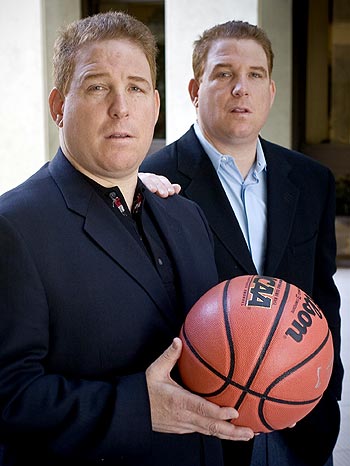
The Yahoo! story described the Pumps as “college basketball power brokers.” What does that mean? It means the Pumps live and feed on the underbelly of Division I basketball. They run AAU teams and summer camps, and have great influence over where a lot of the top high school talent winds up. That gives them leverage with top college coaches and athletic directors, connections that translate to a large number of Final Four tickets, which are then scalped, something they have never denied.

The Pump brothers are certainly connected with the KU program, nine players from their summer traveling teams having gone on to play for Kansas. There are other ties as well, including the fact that the sons of head coach Bill Self and assistant coach Danny Manning are on rosters of the Pump brothers’ teams.

What's the old dictum from Watergate? Follow the money. D-1's corollary: Follow the influence.

Oh, and speaking of corruption …


The basic nexus of talent, access and money that apparently is in play at Kansas would seem to be alive and well at the University of Kentucky where basketball coach John Calipari — no stranger to looking the other way — has recruited one Eric Bledsoe, whose horrible grades magically turned around in one year at a new school — enough, in fact, to meet the NCAA minimum standards.

It appears that the point guard not only suddenly turned into a scholar, someone — his prep coach is suspected — conjured up cash to pay rent for the house where Bledsoe and his mom moved for his senior year.

The NCAA is said to be very interested in Bledsoe’s turnaround.

Such killjoys.

If the Bledsoe story has truth to it, Calipari is fortunate that it was discovered now rather than two years down the road when perhaps he would have had to see a third Final Four appearance vacated.

Friday column:


In 1981 in a match at Wimbledon, a linesman missed a call — or not — and John McEnroe came unglued, famously screaming at the chair umpire, “You can’t be serious — you cannot be serious!” and calling him the “absolute pits of the world” when he refused to reverse the call.

Over one point.

Wednesday night, Detroit’s Armando Galarraga lost more than a point on a bad call — a demonstrably bad call. He lost a perfect game. Which means he lost recognition as only the 21st pitcher in the 134-year history of baseball to retire 27 consecutive men.

What did the 28-year-old Venezuela native do?

He smiled.

Oh, it was a pained smile, to be sure — a rueful smile. But it was a smile.

Yet more impressive than his composure on the field was his composure off it after he retired Mike Redmond for the 27th — actually, the 28th — out.

In the clubhouse, when Galarraga heard that Jim Joyce — the ump who blew the call — was berating himself over the mistake, Galarraga said, “Tell him no problem.” Then he said, “I can go tell him.”

And Galarraga did.

“I know nobody’s perfect,” Galarraga told ESPN, describing the meeting. “He feels real bad.” For his part, Joyce had asked for a chance to apologize, and he did.

“You don’t see an umpire after the game come out and say, ‘Hey, let me tell you I’m sorry,’ ” Galarraga said. “He felt really bad. He didn’t even shower.”

At the time of the mistake, some of the Tigers were less forgiving than Galarraga, and Joyce — to his credit — didn’t have a problem with any of the hot rhetoric.

“I don’t blame them a bit — or anything that was said,” Joyce said. “I would’ve said it myself if I had been Galarraga. I would’ve been the first person in my face, and he never said a word to me.”

The Tigers’ Jim Leyland is one of the most well-respected managers, and on Wednesday he demonstrated why. Described as “livid” at the time of the blown call, he vehemently protested to Joyce but afterward threw the 24-year veteran a lifeline.

“That’s the nature of the business, that’s just the way it is,” Leyland said. “The players are human, the umpires are human, the managers are human, the writers are human. We all make mistakes. It’s a crying shame. Jimmy’s a real good umpire, has been for a long time.”

Because of the egregious nature of the mistake, Major League Baseball briefly considered reversing the call and awarding Galarraga the perfect game. It would have corrected an injustice — and allowed Joyce to sleep at night — but also would have set a troublesome precedent.

Yet Galarraga’s loss is, in some ways, our gain. For on Wednesday he not only gave us a pitching lesson, he gave us one on graciousness. It’s the second lesson that’s the more important.

Contact Jim Gordon at gjames43@msn.com.

Thursday, May 27, 2010

Friday column: Excuses pave way for bad behavior

The human need to engage in denial or justification of wrongdoing is deep-seated.

How deep?

The famed theologian Augustine of Hippo would say it’s a part of the human condition — original sin. In other words, such activity comes with the territory — the territory being mankind — and is about as surprising as, say, a powerful politician getting his church parking lot paved using taxpayer funds.

In the case of disgraced cyclist Floyd Landis, his first response to being busted for using performance-enhancing drugs was to lie. Now, years and millions of dollars later — some of those dollars having come from credulous supporters, his constituents, if you will — Landis is admitting his cheating, though trying to partially justify it with an “everybody-was-doing-it” defense.

In the case of Michigan football coach Rich Rodriguez, his first response to being accused of violating NCAA practice rules was to vehemently deny doing anything wrong, even getting quite emotional over the suggestion that he and his coaches might care more about winning games than getting his players to class on time.

Now, after the university’s own investigation has shown the practice accusations to be true, Rodriguez is trying to justify the behavior. Mistakes were made, he concedes, while quick to add that they weren’t really his fault. He simply didn’t know the university expected its coaches to submit forms designed to track athletes’ activities until he already had been on the job 18 months. Somebody, he said, should have told him.

Actually, Rodriguez didn’t say somebody should have told him; his lawyer said it. Which is definitely the way you want to go. Your mouthpiece being evasive is always superior to you being evasive.

Let’s say you own an asphalt company being investigated in a sheriff’s probe of the Public Works Department — bitumen being the theme of the day. Better than you declining to answer questions from The New Mexican is your lawyer declining for you, and saying something like, “We are trying to respect the investigation and the process.”

To a cynical journalist, that might seem like code for, “We’re still working out our story.” But it still sounds better coming from someone who’s passed the bar.

Of course, there’s only so much an attorney can do.

When a Georgia district attorney declined to prosecute Ben Roethlisberger on sexual assault charges, his lawyer made it sound as if his client was on his way to joining Augustine as a Saint — no, not the NFL kind.

All of which didn’t keep the NFL from suspending the former toast of Pittsburgh for six games — after which Roethlisberger promised to amend his behavior, saying “I intend to make my family, friends and Steeler nation proud on all fronts.”

Which is nice and all, except as we know, the road to the Warm Place is paved with good intentions.

Or is it asphalt millings?

Contact Jim Gordon at gjames43@msn.com.

Thursday, May 20, 2010

Yeah, this is a good use of a coach's time


So, you're Arizona Cardinals head coach Ken Whisenhunt.

You're hard at work, trying to put together a roster, draw up a few new plays, figure out how in hell "coach up" Matt Leinart to replace the retired star quarterback Kurt Warner.

Then you're called away from your work to explain to Darnell Dockett, your 28-year-old defensive tackle, presumably an adult, why taking a shower for all the world to see over the Internet isn’t a good idea — even if you win a $1,000 bet by doing so.

“Obviously, we weren't real excited when (the online video) came out," Whisenhunt said. "We don't discourage our players from having interaction with our fans. In fact, we think it's important. But there's also a right way and wrong way to do it.”

Dockett seemed to get Whisenhunt's message.

"It's a learning experience for me," Dockett said. "I've never been in trouble, I've never been in the news or on gossip sites or things like that. I apologize to all the kids, everybody in the community who looks up to me. I apologize to my team. I walked by each player individually and apologized. I got to do better things than that.”

One would hope so.

As for Whisenhunt — and every other coach in the NFL — may we recommend a course in psychology, child psychology.

Ah, nothing like role models

There appears to be no shortage of athletes in their 20s who act as though they were in their teens — early teens.

But there also seems to be no shortage of parents of athletes, people in their 50s, who also are a long way from growing up.

Take Carrie Mae Stoudemire, for instance.

Stoudemire, 54-year-old mother of Phoenix Suns star Amar'e Stoudemire, this week was arrested by Scottsdale, Ariz., police for failing to have an ignition interlock device on her vehicle.

Carrie Mae apparently has trouble with alcohol — and other things, having been jailed multiple times on charges including drug possession and prostitution.

In the midst of trying to figure out how to get the Suns past the L.A. Lakers in the Western Conference finals, her son was called to the scene of her latest arrest, where her mother began repeatedly calling out his name. Police had to ask Amar’e to leave because his presence was causing his mother to “act out.”

But at least Carrie Mae hasn’t killed anyone that we know of. Can’t say the same for Willie L. Buie, stepfather of Boston Celtics guard Marquis Daniels.

Buie, 55, made the news the other day by getting Tasered at the Celtics-Orlando Magic playoff game. He was charged with resisting arrest with violence, which sounds pretty serious until you compare it with a previous charge Buie faced — second-degree murder.

Yes, he was found guilty. Yes, he spent a long stretch in prison. Yes, some athletes have a great deal more to deal with than we know.

Friday column: Whatever Landis is selling, I’m not buying


So.

Suddenly, Floyd Landis is all about the truth.

After lying for years about his use of performance-enhancing drugs, he wants to come clean and take the fall — whatever fall is left for him — and he wants to take a few others down with him.

Nice.

We knew Landis was a piece of … work … yes, that’s what I was going to say, a piece of … work … when he apparently allowed his business manager to threaten Greg LeMond with public exposure that LeMond had been sexually abused as a child — a piece of information LeMond had confided to Landis.

This, in an attempt to intimidate LeMond into not testifying against Landis at a USADA doping hearing.

Now we’re to believe Mr. Sudden Rectitude when he alleges that Lance Armstrong, Armstrong’s longtime coach Johan Brunyneel, and American riders Levi Leipheimer and Dave Zabriskie were involved in the doping.

In the case of Armstrong, there’s been so much smoke about his possible drug use, it wouldn’t surprise me at all if fire is there as well. Nonetheless, I wouldn’t believe Landis if he told me wheels were round.

To me, Landis’ latest version of reality adds nothing to the case against Armstrong.

Nothing.

* * *

When Hanley Ramirez, 26-year-old shortstop for the Florida Marlins, nonchalantly jogged after a groundball he’d booted into left field — allowing two runners to score — manager Fredi Gonzalez removed him from the game.

Ramirez responded by sulking, refusing to apologize, and taking verbal shots at his teammates and his manager.

So Gonzalez essentially grounded his petulant star, putting his multimillion-dollar fanny on the bench the next game and indicating it might stay there until an attitude adjustment was made. Finally, Ramirez did apologize — to Gonzalez and to each of his teammates, one at a time — and was returned to the lineup.

If “grounding” sounds like a discipline more suitably meted out by a dad or mom than a major league manager, well, that’s true but …

“I think we’re all parents here,” Gonzalez said Wednesday after Ramirez’s apology. “Sometimes our children will say something that hurts, but it’s no big deal, we still love them.”

Now, coaches and managers at the professional and collegiate level shouldn’t have to be fill-in parents, but it seems they’re put in that position more and more. In this situation, Gonzalez did the right thing, taught the right lesson — something Ramirez could benefit from for years to come.

Perhaps Gonzalez taught a few of his managerial peers a lesson, too. That lesson? Sometimes “Junior” has to be dealt with — even when Junior is an All-Star and under contract for $70 million.

Contact Jim Gordon at gjames43@msn.com.