Thursday, March 31, 2011

Friday column: Bryant and Junker — bling and fling


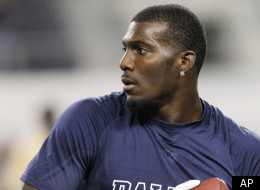
Dez Bryant and John Junker would seem to have little in common.

The first is a 22-year-old wide receiver for the Dallas Cowboys; the second is a middle-age-plus bowl game executive — or was until Tuesday, when the Fiesta Bowl sent the CEO and his $600,000 salary packing.

Bryant’s difficult childhood is well-known; personal information about Junker was hard to come by after his bio was scrubbed from the Fiesta Bowl website, but I don’t believe Junker’s mother birthed her son when she was 15, as did Bryant’s, or spent time behind bars for selling crack.

But the two men apparently do share something — a fondness for playing fast and loose with money not their own.

While still at Oklahoma State, the talented Bryant clearly was headed for a pro payday, but he didn’t want to wait.

A year and a half before inking an $8.5 million deal with the Cowboys, he set up a line of credit through an adviser and begin to make purchases here and there.

Necessities, really.

Like diamond dog tags set in white gold. Like a $60,000 custom charm. Like a $65,000 diamond cross made of white gold. Like nine expensive watches and other assorted goodies.

What’s wrong with that, you ask? Well, nothing, I suppose — if you pay back what you borrow. Bryant didn’t, and now two entities are suing him for $861,350, plus interest and attorney fees.

Junker, as far as we know, isn’t into bling. Instead, his style runs to treating the Fiesta Bowl’s nonprofit funds like his own personal piggy bank. A scathing 276-page investigative report found that Junker benefited from “excessive compensation, nonbusiness and inappropriate expenditures and inappropriate gifts.”

How much are we talking about? At least $360,000 that Junker received was cited, delicately, as being “potentially personal” or “potentially inappropriate;” another $2.26 million was called “undetermined,” meaning more information was needed to determine whether those expenditures were hinky.

Among the more egregious expenses were a $33,000 birthday bash for Junker, a $110,000 Celebrity Fight Night spree, and a $1,200 strip club tab that Junker defended this way: “We are in the business where big, strong athletes are known to attend these types of establishments. It was important for us to visit, and we certainly conducted business.”

I bet they did.

To be fair, Junker did try to spread the wealth around, specifically to local politicians — reportedly hatching a scheme to buy influence by having Fiesta Bowl employees contribute to campaign coffers, then secretly (and illegally) get reimbursed through bogus bonuses.

Bryant and Junker — citizens from different sides of the track, yet both experiencing the ultimate American dream: living large on other people’s cash.

Greed — America’s great social glue.

Contact Jim Gordon at gjames43@msn.com

Friday column: Here's 3 down, but also 3 up

At times, it seems as though the sun's always setting in the world of sports. Just in the last few days, we've seen:

• Hall of Fame linebacker Lawrence Taylor positing that his sexual-misconduct conviction — for patronizing a 16-year-old prostitute — isn't really his fault but that of the "world of prostitution."

• Cowboys wide receiver Dez Bryant acting like a angry toddler when he and his posse are informed by off-duty police officers that the mall they were cruising with pulled-down pants doesn't appreciate their, uh ... overexposure.

• The beginning of a long and expensive trial to determine whether — try not to giggle — Barry Bonds knowingly took steroids.

But even in Toyland, the spherical, hot plasma ball our globe circles also appears to ascend, as Hemmingway said (not quite in those words). Thus:

• British marathon star Mara Yamauchi and coach Martin Yelling have launched a website, runforjapan.com, to mobilize the running community to help relief efforts in Japan.

The idea is for runners from every nation to dedicate one of their runs to Japan, and make a corresponding donation. Collectively, the runners would cover a distance equal to the earth's circumference — 24,901 miles.

As of Thursday, 497 people had dedicated a race — covering a combined 8,682 miles — and made a donation. Athletes from several others sports also have banded together to help the Japanese.

• NBA players' generosity saved a life, a story that has just came to light.

In September 2004, L.A. Clippers assistant coach Kim Hughes was diagnosed with prostate cancer. A surgeon covered by team insurance told him he could safely wait several months to have surgery. Hughes, a former premed student, didn't think so, and found another doctor who could operate within a week.

But that surgeon's services weren't covered by the team's insurance. The Clippers — the organization — said it couldn't help. The Clippers — the players — said they could. Several, including Corey Maggette, Chris Kaman, Elton Brand and Marko Jaric, paid for the $70,000 operation out of their own pockets.

As it turns out, Hughes' cancer was aggressive and was threatening to spread. Says Hughes: "Those guys saved my life."

• As life-savers go, it's hard to beat the story of John Shear, a beloved paddock guard at Santa Anita race track in Arcadia, Calif.

About a fortnight ago, Shear threw his body between a runaway horse and a 6-year-old girl. The girl was physically unscathed; Shear suffered multiple pelvic fractures, a fractured cheekbone, and gashes above his left eye and down his left arm.

Shear has been hospitalized ever since; it's hoped he'll be able to walk again in two months or so.

"Could have been worse," Shear told the Los Angeles Times' Bill Plaschke. "Something could have happened to the little girl."

Quite a story — worth reading in full at lat.com. Oh, by the way, the body Shear put between the girl and the 1,000-pound animal is 90 years old. Shear has worked at Santa Anita for half a century.

Friday, March 18, 2011

That IS better

Now, Jim Tressel says he wants the same punishment as his players — a suspension of five games, instead of the two-game suspension handed out by his university.

Now, says, "I am very sorry for the mistakes I made," not just for the inconvenience to the program and the Ohio State faithful.

That, finally, is owning up. Better late than never.

We'll see if it will be enough for the NCAA.

Friday column: They said (and didn't say) what?

Ah, this week in words:

What Jim Tressel said was inadequate.

What Notre Dame didn’t say was disappointing.

What Cappie Pondexter said was bizarre.

According to The Associated Press, Tressel, Ohio State football coach, on Tuesday “apologized several times during his first public speaking engagement since being suspended and fined for violating NCAA rules.”

Here’s what The AP quoted Tressel as saying to a group of Buckeye fans:

“I sincerely apologize for what we’ve been through. I apologize for the fact I wasn’t able to find the ones to partner with to handle our difficult and complex situation.

“I also apologize because I’m going to have some sanctions.”

Now, The AP may call that an apology, but it appears to me that Tressel — who violated NCAA rules by lying about the violations committed by his players — apologized for everything except for doing something wrong.

Notre Dame has made it clear that the university did something wrong, accepting responsibility for the Oct. 27 death of a student videographer killed when a hydraulic lift blew over as he filmed football practice.

But the school is hardly clear about who made the decision to send up Declan Sullivan on that windy day.

“I don’t (know) a specific person,” athletic director Jack Swarbrick told the Indiana Occupational Health and Safety Administration. “It is done on the administration side of the football program.”

What does that mean? Or, rather, who does that mean? What about head football coach Brian Kelly?

No, Kelly said, he wasn’t in charge of the photographers.

Perhaps video coordinator Tim Collins is the man. After all, when Sullivan reported to practice the fatal day, Collins reportedly told him that practice would be outdoors “contrary to his judgment.”

But when asked by an OSHA investigator if he thought at the time that the lifts shouldn’t be used because of the conditions, Collins said, “No.” This despite the fact Collins balked at sending up a novice videographer — because of the conditions.

Notre Dame, it appears, is obfuscating.

Cappie Pondexter, on the other hand, is … well, you pick a word.

This is what the WNBA player tweeted on the devastation occurring in Japan:

“What if God was tired of the way they treated their own people in there own country! Idk guys he makes no mistakes.”

As if that weren’t enough, the former Rutgers star later added, “u just never knw! They did pearl harbor so u can’t expect anything less.”

After a discussion with her employer, the New York Liberty, Pondexter eventually tweeted, “I wanna apologize to anyone I may hurt or offended during this tragic time. I didn’t realize that my words could be interpreted in the manner which they were.”

In other words, the problem wasn’t so much what she said but how it was interpreted.

On the sincerity meter, her apology moves the needle about as much as Tressel’s. Which is to say, not at all.

Friday column: He's selling, but I'm not buying


Ohio State head football coach Jim Tressel is all about character.

He preaches it to his players.

He talks about it in inspirational speeches.

He writes books about it.

In fact, he was on a book tour to promote his latest tome, Life Promises for Success: Promises from God on Achieving Your Best, when an unfortunate thing happened.

He was outed.

No, not outed like that; outed like this:

Remember when the NCAA busted five Buckeyes for selling Big 10 championship rings, shoes, jerseys and other memorabilia to the owner of a tattoo parlor? That was in December.

When the news broke, Tressel expressed disappointment in his players. He didn’t express surprise; what we didn’t know at the time was that he couldn’t have. Turns out Tressel had been tipped off to the violations in April.

He told the tipper, “I will get on it ASAP.”

Then he did ... nothing.

Didn’t tell his athletic director, didn’t tell his school president, didn’t tell the NCAA — a violation of his contract, by the way.

On Monday, Yahoo Sports broke the story about what Tressel knew and when he knew it. On Tuesday, an embarrassed Ohio State called Tressel back from his book tour so he could lie to the nation’s press.

Whoa! That’s harsh. Maybe Tressel really believes the self-justifying claptrap he offered to explain his failure to tell anyone that star quarterback Terrelle Pryor and four others were committing NCAA rule violations, and that those violations involved an alleged drug dealer.

Maybe he believes it.

I doubt it.

Tressel said he stayed silent because he didn’t want to “interfere with a federal investigation” into drug trafficking. By staying silent, Tressel said, he was trying to protect his players.

He was trying to protect his players, all right — or rather, protect their eligibility — and his chance to get to and win a lucrative BCS bowl game, which the Buckeyes did. Tressel thereby validated his commercial value; he and his program are worth millions upon millions to OSU, which pays him $3.5 million a year in return.

For their actions, the players were suspended for five games in the upcoming season. For covering up their actions, Tressel was suspended two games and fined $250,000, essentially a slap on the wrist.

Asked if he considered firing Tressel for this eminently fireable offense, E. Gordon Gee, the little man who is OSU president, attempted a little humor: “No, are you kidding? Let me be very clear. I’m just hoping the coach doesn’t dismiss me.”

HAHAHAHAHAH.

Actually, Gee’s tiny jest isn’t funny; it’s pathetic, and only too close to truth.

There is something amusing in all this, though — that’s Tressel’s attempt all these years to sell the idea he’s a different breed of Division I football coach.

I wish him luck with his latest book.

Thursday, March 3, 2011

We'll find out draft day

So.

Former Arkansas quarterback Ryan Mallett, confronted by a story that said "heavy rumors of drug use and possible addiction kept him from coming out for the 2010 draft," refused to answer questions about the piece, which was written by former NFL executive Tony Softli.

Well, that's his right, of course.

Here's what Mallett did say: "Obviously somebody did it for a reason, right before the combine, right before the draft. That's the last I'm going to talk about it, though. I've talked to the teams. It's all good."

First of all, I have to admit I cringe every time I hear anyone say, "it's all good" about anything.

Second of all, with character questions in the air and the memory of Ryan Leaf — to whom Mallett has been compared — still hanging on, I'm guessing it's really not all that good.

That's on the outside ...

OK — it's an obvious question, but somebody has to ask it.

Regarding fashion "provocateur" John Galliano, who recently said, "I love Hitler" to two women he thought were Jewish: Exactly how long would Galliano have lasted in the Third Reich.

I'm guessing about ... six seconds.